
Why Exploring France by Coach Makes Sense
Affordable and Eco-Friendly Advantages
Riding a coach across France emits roughly 75% less carbon per passenger than a domestic flight. That figure alone makes the train platform feel archaic. I find the economics compelling! For the price of a single TGV ticket, bus travel france lets you traverse the entire Rhône valley.
The affordability extends beyond the base fare. You avoid hidden luggage fees and land directly at the gates of Avignon, not a distant airstrip. Modern fleets use electric brakes and optimized route planning.
- Fuel consumption per seat mile has dropped by a third.
- Most operators offset residual emissions.
When you factor in the silence of an electric motor and the gentle rhythm of the motorway, bus travel france reveals a pragmatic and elegant way to see the country. It carries a fraction of the carbon cost of conventional tourism.
Comparing Coaches with Trains and Cars
The motorway arcs over the Allier river while the rail line plunges underground. This distinction matters enormously. Bus travel france positions you above the hedgerows, allowing a continuous visual survey of the country, where the TGV corridor offers buried glimpses. At the wheel of a rented car, you negotiate roundabouts and pay tolls; on a coach, you do neither. I find these differences worth weighing:
- The coach drops you at the old town gates, where rail stations stand on the periphery.
- The single seat lets you arrive without driver fatigue.
- Your luggage remains in the hold, never requiring your attention.
Towns appear in obliquely negotiated sidestreets, not as platform announcements. The pace reads as slower, but the absence of transfers and check-in rituals makes the journey surprisingly efficient. Choosing bus travel france over a rental car or a rail pass changes how you remember the geography.
Understanding Regional and Long-Distance Services
France deregulated its intercity coach market in 2015, and the network has expanded since. Understanding the two service levels changes how you plan bus travel france. Regional services, subsidized by local authorities, run through the countryside, stopping at villages where train tracks have been removed. Long-distance routes follow motorway corridors between major cities.
Regional coaches align with school and work rhythms, serving markets, clinics, and rural hubs. Long-distance coaches offer multiple daily departures, onboard restrooms, and power outlets. Booking and budgeting differ too. Regional tickets are often capped at a few euros, while long-distance fares fluctuate with demand.
- Regional lines: short hops, frequent stops, fixed low fares
- Long-distance lines: high-speed corridors, reserved seats, dynamic pricing
Both networks feed into each other. Combine a regional coach to a rail hub, then a long-distance coach onward. Bus travel france is two-tiered. Using both tiers well covers ground efficiently.
Best Times of Year for Coach Journeys
Exploring France by coach unlocks a rhythm of travel that trains cannot match. The best times for bus travel france often surprise first-timers. I have watched the countryside shift from lavender fields in July to golden chestnut groves in October! Each season presents a distinct backdrop for your journey.
Consider these optimal windows:
- Late spring (May to mid-June): long evenings and blooming valleys.
- Early autumn (September to early October): harvest colors and gentle temperatures.
Winter offers the lowest fares, but you will need to adjust for fog and shorter days. Summer demands early bookings and patience with crowds. My personal favorite remains a May morning, when the air carries freshness and the roads feel open.
Mapping Out Your Journey Across French Regions
Top Tourist Routes and Scenic Drives
Seventeen mountain passes separate Lake Geneva from the Mediterranean coast. That distance is the Route des Grandes Alpes, and a coach can cross it in a single day. Most travellers underestimate the scale of France. The country spans 13 regions, and the bus network links them with surprising precision. For bus travel france, the Route des Grandes Alpes delivers the highest drama. The Corniche d’Or hugs the Mediterranean cliffs, while the Gorges du Tarn slices through limestone canyons.
Plan your journey along these corridors:
- Route des Grandes Alpes: 700 kilometres of switchbacks.
- Corniche d’Or: coastal cliffs between Saint-Raphaël and Cannes.
- Gorges du Tarn: a narrow canyon path linking Millau and Florac.
Each region carries its own character. Provence glows with lavender fields in July. Brittany offers rugged shorelines battered by the Atlantic. The quality of your bus travel france experience depends on aligning the route with the season.
How to Book Tickets and Travel Passes
France has over 3,000 coach stops, yet most travellers never see them. Mapping a journey across French regions demands more than a vague itinerary. The coach network connects villages that rail lines abandoned decades ago. A single booking can carry you from the alpine foothills to the Atlantic coast without a transfer.
To secure your bus travel france tickets, use regional platforms such as ZOU! for Provence or BreizhGo for Brittany. For longer arcs, Blablabus simplifies cross country planning.
- Validate your ticket on the driver’s terminal before boarding.
- Keep your pass visible for inspectors.
Travel passes, like the France Pass or regional multi ride cards, often cover buses too. Check the fine print, because some passes exclude resort routes during July. A little research spares you from buying separate tickets at the last moment.
Navigating Bus Stations and Stops
Rural French bus stations rarely announce themselves. A weathered sign, a shelter, sometimes just a post with a timetable behind glass. The coach pulls up, doors hiss, and you have thirty seconds to board. Knowing your stop matters more than knowing your route.
Mapping across regions means reading the landscape as much as the schedule. In Normandy, stops cluster near markets. In the Massif Central, they sit at valley junctions where three roads meet. The driver knows the regulars by name, but tourists are welcome too. Before your bus travel france trip, pull up the operator’s map and note the landmarks near your stop.
- Arrive ten minutes early; rural stops have no screens.
- Check both sides of the road; some routes reverse direction.
- Ask the driver to call out your stop if you are unsure.
Bus travel france works best for those who pay attention. The landscape, the stop signs, the driver’s call, all of it becomes part of the route.
Useful Apps and Websites for Schedules
Only a third of French bus stops in rural areas have electronic arrival boards. That statistic reshapes how you approach the timetable. For bus travel france, the digital map is fractured. Each region operates its own system, and none speak to one another. The Auvergne Rhône Alpes portal shows live departures for coaches, while Normandy’s platform lists only static schedules. Third party apps aggregate long distance lines, but miss the local service.
- Regional transport authority websites
- Operator specific apps for live tracking
- Printed timetables at tourist offices
A traveller triangulates these sources to navigate. The journey becomes an act of interpretation rather than simple lookup. Crossing regions demands this careful read.
Connecting to Rural and Remote Destinations
Once you accept the fractured map, routing becomes a puzzle. The rural network survives on connections that don’t appear in any single interface. A morning coach from Lyon to Le Puy-en-Velay might link with a minibus that only runs on school days. That minibus is your only path to a village like Saint-Julien-Chapteuil.
Every journey involves three sources:
- The regional portal for main corridors.
- The local operator for school bus overlaps.
- The tourist office for seasonal changes.
Each source reveals a different slice. The portal shows the main routes. The operator knows the local circuit. Bus travel france in rural areas depends on these unofficial overlaps. Even the best aggregator misses them. You close the gap yourself! That is how bus travel france works.
Key Coach Operators Serving France
International Giants: FlixBus and BlaBlaBus
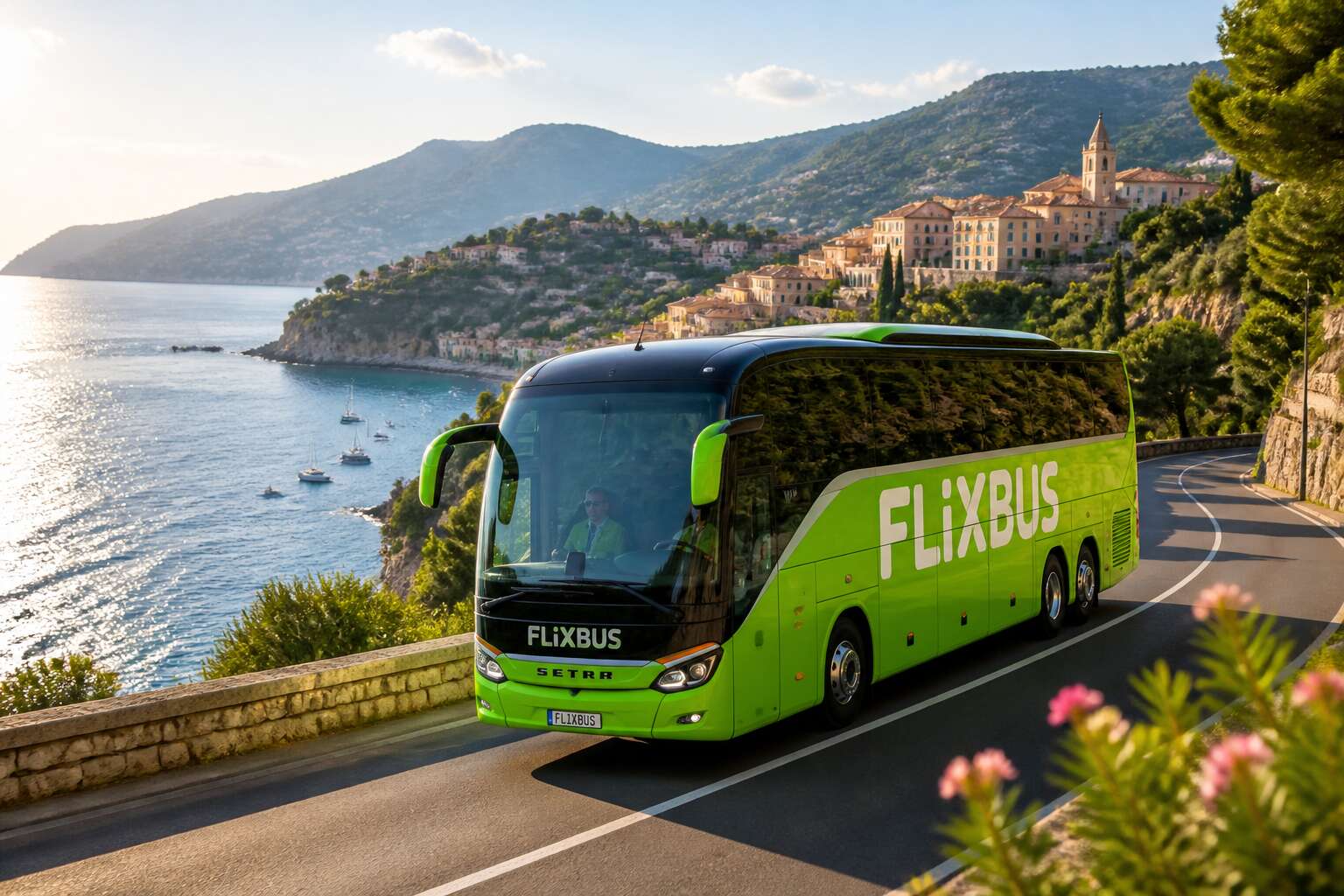
Two names haunt the French asphalt: FlixBus and BlaBlaBus. Each commands its own legion of coaches, slicing through provincial fog and city haze. FlixBus, the German giant, weaves a dense web across Europe, while BlaBlaBus, once the bus arm of a carpooling empire, speaks with a distinctly French accent.
These carriers dominate corridors that rail lines ignore. They deliver passengers to forgotten towns at odd hours, often under a moonlit sky. For the wanderer seeking economical passage, bus travel france becomes a ritual of grey seats and rolling landscapes.
- FlixBus paints its fleet in acid green, a beacon of German efficiency.
- BlaBlaBus favors muted blue, hinting at its carpooling lineage.
Their presence reshapes the country’s transport skeleton, a quiet revolution with diesel breath.
Homegrown Regional Carriers
A coach driver in Auvergne once told me passengers know his exact Wednesday delay to the minute. That intimacy defines France’s homegrown operators.
These carriers rarely advertise, but they move thousands of commuters, students, and elderly shoppers. Firms like Transdev and Keolis operate regional routes under municipal contracts, while family businesses handle school runs and market day shuttles. Their coaches hold 20 to 40 seats, and their timetables follow village routines.
Some examples of regional forces in bus travel france:
- Transdev and Keolis run much of the regional network under local authority contracts.
- Isilines, folded into FlixBus in 2019, still leaves traces on northeastern routes.
- Family firms, dozens of them, serve villages and rural markets with small minibuses.
Fares on these lines can undercut SNCF tickets by a third, and stops sit closer to homes. Anyone planning bus travel france will find that these operators matter as much as the international giants.
Local Commuter and Tourist Coach Lines
Every summer morning, a dozen coaches leave Lyon’s Perrache station before 7 a.m., each bound for a different Alpine valley. I have seen this departure ritual repeat for years. These are not FlixBus machines but the tourist coach lines operated by regional companies whose names appear only on the vehicle’s side. For bus travel france, these operators serve both commuters and holidaymakers.
In Paris, Tootbus and Open Tour run open-top double-deckers with recorded commentary in six languages. A single ticket covers the full loop, and passengers hop on and off at landmarks. These firms also handle private charters for school groups and corporate events.
Local commuter lines handle the daily load. The same coach that takes tourists to a hilltop village at 10 a.m. might return as a school bus at 4 p.m. This dual role keeps fares low and routes viable. Anyone planning bus travel france will find that dual-purpose operators reach places the big networks miss.
Comparing Amenities, Pricing, and Onboard Services
Coach operators in France have built separate identities from the same tarmac. FlixBus prices shift minute by minute, a Paris to Marseille ticket ranging from €9 to €39. BlaBlaBus uses a calmer algorithm, rarely exceeding €25 for the same route. The onboard experience splits along similar lines. FlixBus packs rows tighter but provides reliable USB ports at each seat. BlaBlaBus allocates more legroom and offers a dedicated quiet zone. For bus travel france, your tolerance for noise and price volatility decides the match.
Selection criteria for a coach trip:
- Ticket flexibility: FlixBus allows free date changes, BlaBlaBus charges a fee.
- Luggage: both include one large case and one carry on.
- Entertainment: FlixBus has a streaming app; BlaBlaBus does not.
Regional operators now merge into these networks, but their older coaches carry a simpler charm: human ticket checks and coffee from a thermos.
Sustainability Practices Among Operators
French coach operators now compete on fuel economy as fiercely as ticket prices, with modern fleets averaging roughly 30 grams of CO2 per passenger kilometer. FlixBus has placed 40 double deckers on domestic routes, reducing per passenger emissions by nearly half. BlaBlaBus funds carbon offsets on every ticket, with reforestation projects in the Auvergne. Regional operators such as Transdev trial biofuel blends across Provence.
Current sustainability initiatives include:
- Retrofitting older engines to Euro 6 standards
- Installing solar arrays on terminal roofs
- Switching to lightweight seat frames
For bus travel france, the environmental record improves steadily. A Lyon to Paris coach journey emits around a sixth of the CO2 of a solo car ride, and newer fleets shrink that number every year.
Loyalty Programs and Group Discounts
Twenty passengers on one coach can reduce the cost per seat by more than a quarter, and that reality shapes how clubs, schools, and conference organizers plan trips. Loyalty programs from the main operators add further value for repeat solo travelers.
FlixBus credits each booked journey to a personal account, where points mature into fare reductions on future routes. BlaBlaBus runs a three tier loyalty system, giving frequent riders priority boarding and a complimentary ticket after every tenth journey. Smaller carriers in Normandy and the Loire Valley bundle group discounts with flexible cancellation policies, making bus travel france more practical for local organizers.
- Groups of 10 to 15 receive a 15% discount
- Groups over 30 receive a free organizer seat
- Monthly commuters earn double points
When planning bus travel france, these mechanisms reduce costs for organized travel and regular movement between cities.
Smart Tips for a Smooth and Budget-Friendly Coach Trip
Packing Essentials for Different Seasons
A single carry-on can hold everything you need for a week of bus travel France, if you know the seasonal tricks. Summer demands breathable layers and a refillable bottle, while winter requires thermal socks and a scarf that doubles as a pillow. Spring and autumn are fickle, so I always pack a compact rain shell!
For a smooth trip, keep these items within reach:
- Power bank with multiple ports
- Travel-sized toiletries
- Neck pouch for passports
- Snacks that won’t crumble
This approach cuts stress and costs, since you avoid buying overpriced essentials en route. Coach storage is limited, so travel light and check weather forecasts before departure. Packing smart means more time enjoying the scenery and less time rummaging through bags.
Luggage Rules and Onboard Etiquette
For bus travel France, weight limits are not suggestions. A driver in Lille rejected my friend’s duffel for bulging past 23 kilograms. Every operator posts hold bay dimensions, so check before queueing. Excess luggage fees can eclipse the fare itself.
Onboard etiquette demands quiet discipline. Overhead bins are for jackets and daypacks, never wheeled cases. Earphones stay in from departure to arrival. Reclining seats? Only behind empty rows, and never during the first hour.
- Guard your footwell, it is shared space
- Drink water, skip coffee to avoid toilet stops
- Exit through the rear door to speed boarding
These unspoken rules make bus travel France smooth. They protect your budget, since cleaning fees for spills run high, and a courteous nod to the driver often earns a better stop.
Strategies for Finding Cheap Fares
The courteous nod that earns a better stop also applies to how you plan your purchase. For bus travel france, the gap between a bargain and a splurge often comes down to timing, not luck. Prices shift hourly on popular routes like Paris to Marseille. A search on a Tuesday morning can reveal fares that Friday evening hides.
The flexible traveller has the advantage:
- Shift your departure to off-peak hours
- Travel midweek instead of on weekends
- Accept a longer layover for a lower fare
These choices demand more time, but they return real euros. And a smooth coach trip depends on spending wisely, not packing lightly. Booking early helps, but booking smart helps more. For bus travel france, the traveller who watches price trends, not just the departure board, comes out ahead.
Making the Most of Overnight Services
Riding the overnight coach across France feels like a quiet conspiracy against the cost of lodging. You pay for a seat, and the country unspools outside your window while you sleep. For budget conscious travellers, bus travel france combines the cost of a bed and a ticket into a single fare, saving both euros and daylight hours.
The trick is preparation. Carry a neck pillow that actually supports your head, noise cancelling headphones, and a scarf that doubles as a blanket. Choose a seat away from the toilet and the engine hum.
Remember that stations at 3 a.m. have their own rhythms:
– Check the operator’s policy on overnight stops
– Set an alarm for your stop, not just your destination
– Keep your phone charged and your ticket screenshot saved
BlaBlaBus and FlixBus run several routes through the night. For anyone weighing a hostel bill against a midnight departure, bus travel france offers a compelling middle path. A well planned night journey turns wasted hours into travel time.
0 Comments