
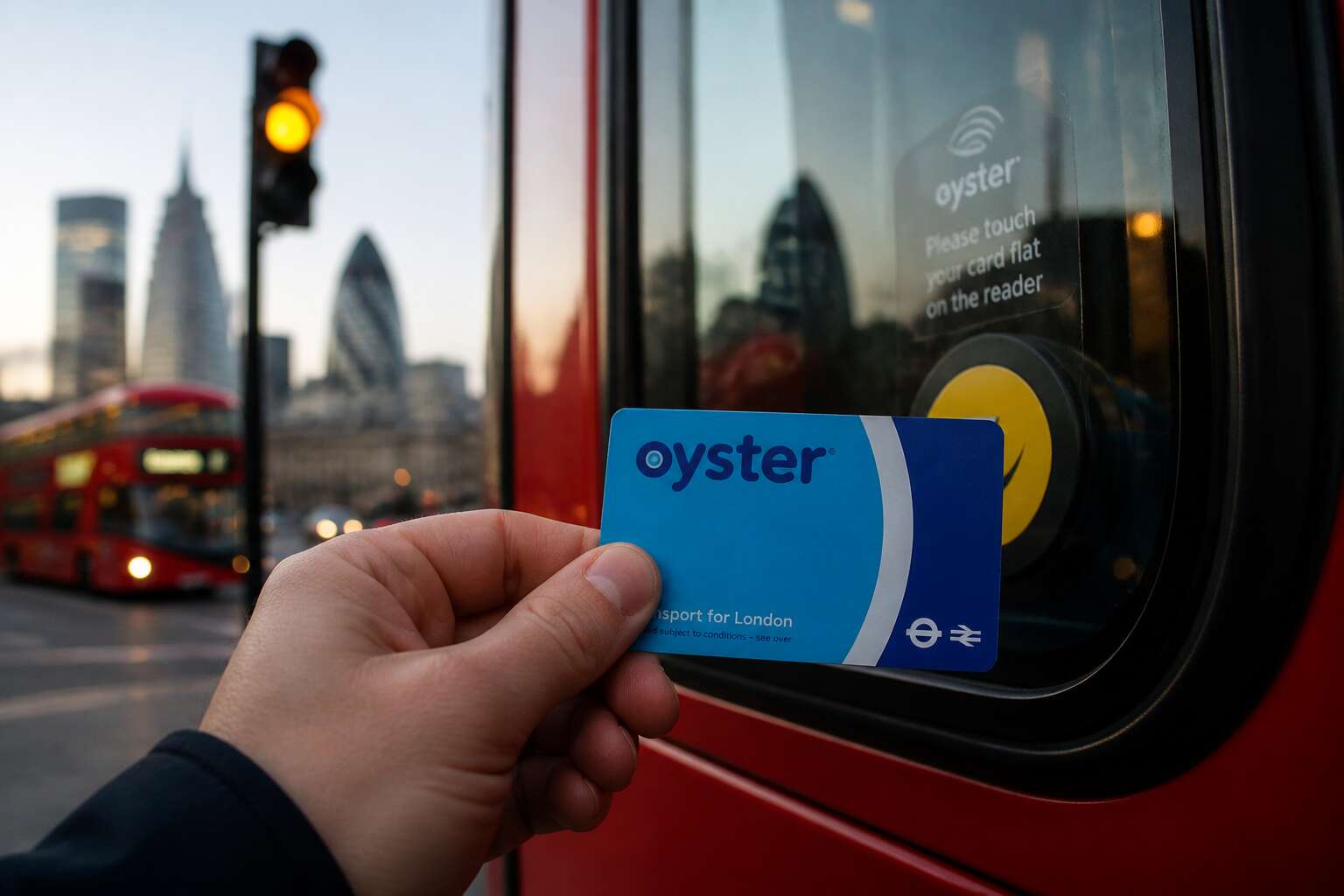
Getting Started with Contactless Payments on London Buses
What Is an Oyster Card and How Does It Differ from Contactless Cards
Each morning, more than six million journeys begin with a tap against a yellow card reader on a London bus. That single tap decides the fare, the daily cap, and how much foreign visitors ultimately pay. For South Africans, the choice between an Oyster card and a contactless bank card is not immediately obvious, but it shapes the entire bus travel oyster card experience from the first ride.
An Oyster card is a prepaid smartcard holding credit that you spend as you ride. You top it up online or at a station kiosk before boarding. A contactless card, by contrast, links directly to your bank account. The reader takes the fare from your bank after you travel, usually overnight. Both methods apply the same daily cap, yet they operate through separate systems with different customer protections.
The differences matter in practice:
- Oyster requires a £5 deposit, refundable at the end of your trip.
- Contactless charges through your bank’s exchange rate.
- Oyster offers lost card protection if you register it.
That is why a bus travel oyster card suits longer visits, while contactless works for a quick weekend in the city. The physical Oyster card itself is a small blue oval you can keep as a souvenir; contactless leaves nothing behind but a line on your statement.
Where to Buy and Top Up Your Travel Card
Contactless payments on London buses are elegantly simple. You tap your South African bank card, and the fare settles overnight through your bank’s exchange rate. No prepayment, no deposit, no paperwork. The daily cap applies without you ever thinking about it.
If you favor the tangible routine of a physical card, the bus travel oyster card is sold at every Tube station, visitor centre, and Oyster Ticket Stop. I always tell visitors to top up before boarding, since drivers do not accept cash. These options cover most travellers:
- Ticket machines accept notes, coins, and bank cards.
- Online top-ups via the TfL website take seconds.
- Newsagents and convenience stores sell instant credit.
How to Touch In and Out Correctly on Single-Deck and Double-Deck Buses
One tap. That is the entire transaction on a London bus. Unlike the Tube, where the turnstiles demand a farewell tap at your destination, the bus fare is a single flat charge. The moment you board, your payment is complete.
The process is straightforward:
- Find the yellow card reader. On single-deck buses, it sits beside the driver. On double-deck models, a second reader stands near the middle doors.
- Hold your card flat against the reader. Whether you carry a South African bank card or a bus travel oyster card, the motion is identical.
- Wait for the green light and the single beep. Then move down the aisle.
There is no exit tap, no farewell ritual, no second thought. The reader has done its work. You are free to find a seat upstairs and watch London pass by your window.
Understanding Daily and Weekly Price Caps for Bus-Only Travel
Three trips on a London bus in one day and your travel costs stop. For bus-only travel, the daily cap of £5.25 settles your account after three single fares. This applies whether you use a bus travel oyster card or any contactless bank card from South Africa.
Contactless payments on London buses require no setup and no paperwork. Your payment card is sufficient! The system records each tap and applies the correct charge automatically.
The weekly ceiling follows the calendar week from Monday to Sunday. At £26.20, it resets with no effort from you and captures seven days of bus journeys.
The fare structure rests on three figures:
- £1.75 for a single bus journey
- £5.25 for the daily cap
- £26.20 for the weekly cap
Fares, Discounts, and Smart Money-Saving Strategies
Current Pay-As-You-Go Bus Fare and Peak Versus Off-Peak Rates
Some riders clutch their bus travel oyster card as if it held a secret. It does, but not the one you think. The current pay as you go bus fare sits at a flat £1.75, regardless of the hour. There is no peak versus off peak pricing on London buses. The price stays stubbornly identical whether you board at sunrise or midnight.
Discounts arrive in specific forms. The 60+ Oyster, the 18+ Student photocard, and the Veterans Oyster card all slash the fare or remove it entirely. Pay as you go remains the most flexible route, though your bus travel oyster card can also pair with a Bus & Tram Pass if you commute daily. Consider the arithmetic:
- Three payable journeys reach the daily cap
- Weekly caps lock after roughly eight rides
- A monthly pass suits riders crossing seventeen trips weekly
The absence of surge pricing makes bus travel predictable. That consistency is the real saving, quiet and reliable.
The One-Day Bus Pass vs. Capping: Which Works Better
One fare structure hides a quiet mathematical nuance. A single ride costs £1.75, but a full day of boarding transforms into a different equation. The one-day Bus & Tram Pass requires £5.60 paid in advance. Your bus travel oyster card, in contrast, tracks each ride and stops charging once you hit the £5.25 daily cap. That means three trips break even, and every fourth ride becomes free.
- Three bus rides: the cap saves you 35p compared to the pass
- Two bus rides plus one tram ride: the pass covers the tram, the cap does not
- Four or more bus rides: the cap remains at £5.25, the pass stays at £5.60
The pass only justifies itself when trams enter your route. For pure bus travel, the cap is your quiet ally. I find that consistency refreshing, honestly!
Child, Student, and Senior Concessions Explained
More than a million concessionary Oyster cards circulate through London’s transport network, yet most South African visitors travel on standard adult fares. The concession system separates riders into distinct groups with distinct rules.
For children, the arrangement is straightforward. Under 11s board for free without holding any card. Riders aged 11 to 15 should carry a Zip Oyster card, which halves the bus travel oyster card fare to around 90p per journey.
- Under 11: free bus travel, no card required
- Ages 11 to 15: Zip Oyster card, half the adult fare
- Students 18 and over: Student Oyster card, 30% off Bus & Tram Passes
Students occupy a middle ground in this hierarchy. The Student Oyster card offers 30% off Bus & Tram Passes but does not reduce pay-as-you-go bus travel oyster card fares.
The senior concession belongs exclusively to London residents aged 60 and above. Visitors from Johannesburg, Cape Town, or Durban do not qualify for free travel.
Using Railcards and Travelcard Combinations to Lower Costs
An Oyster card loaded with pay-as-you-go will not apply a railcard discount to your bus travel oyster card fare. However, a railcard still cuts costs on bundled tickets, particularly if you plan any rail journeys around London. The Off-Peak Day Travelcard covers buses and tubes, and a Network Railcard reduces the price by a third.
- Choose a Travelcard when you expect three or more bus trips in a single day.
- Load your railcard onto the same Oyster card before buying a Travelcard online.
- Compare the 7-Day Travelcard with a Bus & Tram Pass for longer stays.
A Bus & Tram Pass never receives a railcard discount, yet combining it with a discounted rail ticket often beats paying standard fares. For visitors from South Africa, this layered approach lowers the overall transport bill without touching daily or weekly caps.
How Free Bus Transfers Within One Hour Affect Your Wallet
London’s buses have a hidden rule: touch in again within one hour and the second journey costs nothing. The bus travel oyster card records these transfers automatically, so your pocket only feels the first fare.
This shifts how I approach my day. Instead of squeezing errands onto one route, I split them across two buses. The hour window absorbs the second ride. The daily cap still applies, but the transfer reduces the real cost per trip.
- Two bus rides inside one hour: one fare
- Three rides, spaced with care: still capped at the daily limit
- The hour resets from each touch-in
For anyone from South Africa adapting to London’s buses, this grace period means a single fare can cover a return journey within the hour. The wallet stays intact, and the bus travel oyster card quietly handles the arithmetic.
Hidden Savings with Auto Top-Up and Direct Debit
Auto top-up changes the psychology of the ride. I never watch the balance fall. The bus travel oyster card links to my bank, and the top-up triggers when the stored value dips below a set threshold. This means no scrambling for a machine at the station.
Direct debit adds a layer of quiet consistency. The monthly statement arrives, and I see the bus travel oyster card’s recorded fares. Some riders fear overdraft risks, but I have found automation eliminates the stress of a declined card.
A few practical considerations:
- Set the trigger threshold high enough to cover a week of travel.
- Use the same bank account for all top-ups.
- Check the transaction history monthly.
The hidden saving is time. A few seconds saved at the reader is a few seconds closer to your seat.
Step-by-Step Guide to Smooth Bus Travel with Your Card
How to Locate the Yellow Card Reader and Avoid Double Charging
The yellow card reader on a London bus is a small, unassuming device. I have seen tourists pat their pockets in panic, then tap the reader twice in confusion. To avoid double charging, do not touch your card to the reader more than once. Locate the reader near the driver, or on the middle doors of newer buses. Wait for the beep or green light. A simple sequence works:
- Check the reader’s screen for the correct fare.
- Tap once, firmly but briefly.
- Wait for confirmation before pulling away.
That single tap is your entire bus travel oyster card transaction. The reader records your entry only. No exit tap is needed on buses. Double charging happens when you tap again to see if it worked. Resist the urge. One beep means done. Master this bus travel oyster card routine, and your wallet will thank you!
What to Do When the Reader Shows Insufficient Balance
The reader flashes red. No beep! The screen shows INSUFFICIENT BALANCE. For the unprepared rider, this is the moment of silent dread.
I have watched travelers pause at the yellow reader, blocking the entire queue while they rummage for a coin or hope for a second tap to work. It will not work. The card holds no money, so no signal reaches the system.
Here is the sequence that saves time and embarrassment:
- Step away from the reader immediately.
- Let the next passenger board.
- Decide: contactless payment, a paper single ticket, or an immediate top-up via the TfL Oyster app.
- If you top up, wait for the update to reach the reader. It is not instantaneous.
Your bus travel oyster card depends entirely on the e-money loaded before boarding. A tapped card with zero value produces nothing but a red screen.
Managing Multi-Modal Journeys That Combine Bus and Tube
London’s buses carry over six million passengers a day, and many of those riders carry the same bus travel oyster card onto the Tube minutes later. The system treats bus and rail as separate journeys, but your card remembers both.
The smooth sequence is simple: board the bus, tap the yellow reader, and take your seat. At the station, tap the same card on the gate validator. The fare for the bus leg is deducted, and the Tube leg starts fresh. No need to tell the machine what you plan to do.
For a typical multi-modal commute, follow this order:
- Tap once on the bus reader and wait for the green light.
- Keep the card away from phones and bank cards.
- At the Tube gate, tap the same card on the validator.
- Check the screen shows the correct entry station.
That is the whole trick! The bus travel oyster card does the heavy lifting, as long as you use one card for the entire journey. Mixing a contactless bank card and an Oyster card across modes interrupts the daily cap calculation, and you pay more than necessary.
Checking Your Journey History and Refunds Online
Your bus travel oyster card stores a record of every bus fare. To see where your money went, log into your TfL account and inspect the journey history. Each bus ride appears with its charge, timestamp, and route number. That transparency lets you spot errors before they cost you more.
- Register the card on the official site.
- Review each journey entry against your own records.
- Select any duplicate or unexplained charge.
- Submit a refund request through the same portal.
Refunds usually land within a few working days. The balance adjusts itself, no new card required. The online system handles the entire process, from verification to crediting.
Tips for Tourists: Renting a Card vs. Buying a Visitor Oyster
London’s 9,300 buses move six million passengers daily, yet the biggest obstacle for tourists is not the traffic. It is the choice between a Visitor Oyster and a rental card. I have watched travellers argue over this exact decision!
First, scrutinise your itinerary. For bus-only trips, the Visitor Oyster works fine. Second, calculate the deposit. A rental card costs £5 upfront, refunded on return. A Visitor Oyster has no deposit, but neither does it refund leftover credit.
Run through this checklist before you decide.
- Rental card, £5 refundable deposit, top-ups via the TfL app, balance returns to your bank.
- Visitor Oyster, no deposit, non-refundable balance, sold at tourist shops and stations.
Finally, weigh convenience. If your bus travel oyster card needs a top-up at 7 a.m., the rental card wins. If you want a souvenir, the Visitor Oyster wins. Either way, the right bus travel oyster card makes the journey smoother.
Dealing with Problems, Lost Cards, and Refunds
What Happens If You Forget to Touch Out or Touch In Too Early
Forgetting to touch out on a London bus is rarely catastrophic. Your fare is capped at the daily limit, and the card reader simply logs an incomplete journey. Touching in too early, however, can register a different boarding point. This error may distort your journey history, but a quick check on the TfL portal resolves it.
Lost cards demand immediate action. Report the loss within 24 hours to shield your balance. The replacement fee is modest, while transferring leftover credit takes about five working days. Duplicate charges on your statement? Refunds are straightforward through the official portal.
- Review your journey history weekly
- Report lost cards the same day
- Claim refunds for overcharges promptly
For South African visitors, your bus travel oyster card stays secure when you act quickly.
How to Report a Lost, Stolen, or Damaged Card
Losing your bus travel oyster card is a special kind of London panic. The good news? The replacement process is more boring than tragic. Here is how to report the disaster:
- Call TfL or log into your online account. Do this within 24 hours. Speed protects your remaining balance. This applies whether the card was nicked or simply misplaced.
- Pay the modest replacement fee, around £5. Then wait about five working days for your credit to transfer to the new card.
- For a damaged card, report it as faulty and mail it back. You might even get the £5 deposit refunded.
Keep your journey history handy when you claim. The portal asks for specifics, so don’t rely on memory. Write down your card number somewhere safe. Your future self will thank you. The bus travel oyster card replacement process is straightforward, but only if you act quickly. A little paperwork now saves a lot of wallet grief later.
Requesting a Refund for Unused Credit and Deposits
Refunds feel like breaking the system, but TfL expects them. Your bus travel oyster card holds your money, and when you no longer need it, you can reclaim every pound in unused credit along with the £5 deposit.
Visitors often miss this. Locals forget it. The refund process is cleaner than you think:
- Go to a Tube station ticket machine with your card.
- Select the refund option.
- Get instant cash for your remaining balance.
If you want the deposit back too, you must surrender the card itself. This works for damaged cards as well, though the £5 deposit only returns if the card is faulty. Requesting a refund is a quiet bureaucratic victory. Do not leave your balance to vanish in a drawer.
Disputing Incorrect Charges and Getting Your Money Back
Your bus travel oyster card should work flawlessly every time. It usually does, but occasionally a faulty reader charges double, or a system glitch bills you for a journey you never boarded. Instead of swallowing the loss, know that TfL has a structured process for disputing incorrect charges. You will need to provide evidence, so gather the essentials before contacting them:
- the exact date and time of the disputed journey
- your 16 digit card number printed on the reverse
- a screenshot of your journey history from your online account
Submit these via the TfL contact form. If your card is already lost, you can still recover the money, but you must supply additional proof like top up receipts. The process takes patience, yet it works. Each dispute is investigated on its own merits, and legitimate errors are refunded promptly. Do not let an unjust charge rest on your record.
Common Error Messages and How to Fix Them at the Machine
When the reader flashes an unfamiliar error, your bus travel oyster card can seem stubborn. Most issues are simple. Press the card flat against the yellow reader for a second longer. If it still fails, wipe the chip with a dry cloth.
Common messages and fixes:
- Seek Assistance: the card is damaged, use a ticket machine
- Card Not Accepted: try another reader or your wallet
- Insufficient Balance: top up before boarding
For lost cards, report immediately via the TfL website. Your remaining credit can be refunded to your bank account. The machine itself might print a code on your receipt. Keep that receipt, it is your proof for a refund claim.
Comparing Oyster with Other Payment Options for Bus Travel
Oyster Card Weighted Against Mobile Payments and Contactless Debit Cards
A phone wallet can fail you at the worst moment. That is why the bus travel oyster card still holds an edge for regular riders. The Oyster system processes transactions faster than most mobile wallets, which matters when a queue is building behind you. Contactless debit cards link directly to your bank account, exposing every tap to potential scrutiny. Mobile payments add friction, since you must unlock your phone and authenticate before touching the reader.
Consider the practical differences:
– Oyster hides your banking details from the reader
– Contactless leaves a visible trail on your statement
– Mobile payments depend on battery life and signal
For daily commuters, Oyster remains the simplest tool. It does one thing and does it reliably!
When a Paper Bus Ticket or Pass Still Makes Sense
London’s red buses carry more than five million passengers each day, yet the paper ticket still has a place. For the unbanked traveller or the tourist who wants zero digital footprint, I find the paper bus ticket removes the need for deposits, top-ups, and card registration. The bus travel oyster card excels for regular commuters, but occasional riders often discover a paper pass is cheaper than paying the £5 card deposit. Situations where paper still wins:
- A single journey without any intention of returning.
- A group paying together with cash.
- A visitor who refuses to carry another plastic card.
Paper passes also offer a fixed cost. No hidden capping logic, no refund paperwork, no expiry anxiety!
Using the TfL Go App to Manage Your Travel Balance
Around 60% of all bus journeys in London are now paid for with a contactless device, yet the bus travel oyster card still anchors the system for millions. The difference is subtle but meaningful. A contactless debit card taps the same reader, applies the same fare, and calculates the same daily cap. The oyster card, however, keeps your transport spending separate from your bank account. That separation matters when you want to review a month of travel without sifting through general card transactions.
The TfL Go app changes how you interact with that balance. You can view your remaining credit in real time, check journey history, and see exactly when the daily cap was reached. For a bus travel oyster card user, this visibility is a practical advantage. A contactless card offers no such window unless you manually check your bank statement.
Mobile payments like Apple Pay and Google Pay mirror contactless but add a layer of dependency on your phone’s battery. The oyster card works independently of signal, power, or app updates. The TfL Go app serves as a management tool, not a requirement for travel. You can top up, set auto top-up thresholds, and inspect past trips without ever linking a bank card to the physical card itself.
– View the remaining pay as you go credit.
– Check the current daily cap status.
– Review the last eight weeks of journey history.
The app also lets you register your card, which protects the balance if you lose it. That registration process requires a few minutes but provides a safety net that paper tickets never offer. For riders who prefer a tangible record of expenditure, the combination of a physical oyster card and the TfL Go app delivers the clearest picture of what each journey costs.
Future of Ticketing: What Comes After the Oyster Card
The bus travel oyster card holds an advantage over newer payment options. Contactless bank cards and mobile wallets are faster at the reader, but they blur travel spending with everyday purchases. That separation matters for anyone tracking a transport budget.
What comes after the oyster card? Nothing replaces it, perhaps. The future leans toward account based ticketing, where the physical medium matters less than the system behind it. You might tap any device, or walk past the reader without touching.
TfL supports several payment paths:
- Contactless bank cards
- Apple Pay and Google Pay
- Oyster with auto top up
Each option uses the same fare engine. I find the bus travel oyster card the most transparent choice. It shows clear journey history without bank statement noise. Phone payments carry the risk of a dead battery. The card does not. For a South African traveller, an oyster card avoids foreign transaction fees.



0 Comments