
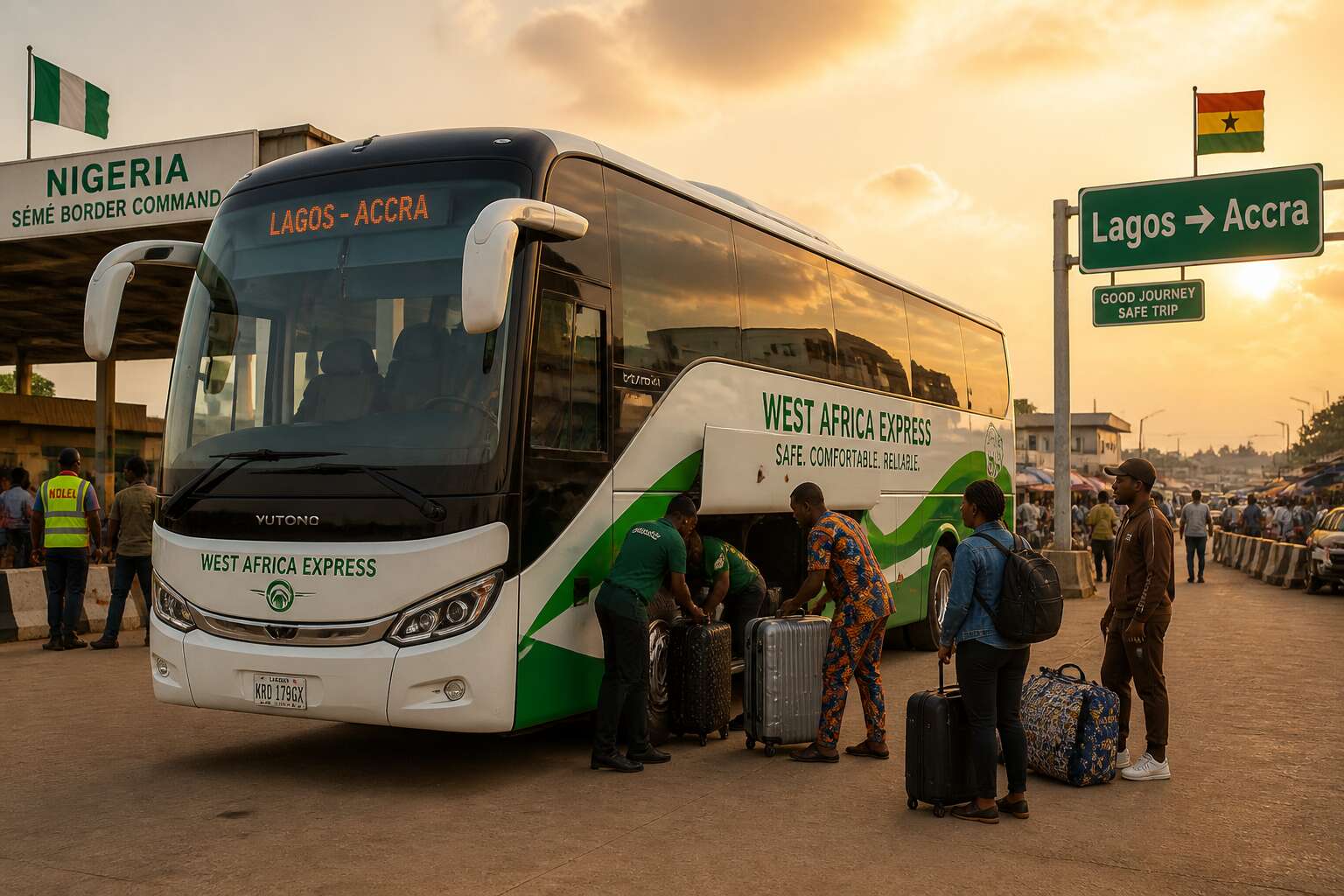
Planning Your Overland Trip Between West African Neighbors
Distance and Typical Journey Time
The direct route from Lagos to Accra is roughly 500 kilometers, a distance that sounds manageable until you factor in the border and the road. For bus travel from nigeria to ghana, the typical journey time runs between 12 and 16 hours, but that figure can balloon when queues at Seme or Aflao stretch for hours.
- The time of day you depart, as overnight buses avoid the worst traffic.
- The condition of the highway after rains, which can slow progress to a crawl.
- The patience of officials at immigration, unpredictable at the best of times.
Most operators schedule overnight departures, so you sleep through the worst of the delays. Expect toll points and checkpoints every hour, each one adding minutes to the clock. When planning bus travel from nigeria to ghana, the distance is constant, but time is the variable.
Border Crossing Fundamentals
The border is a place of small, crucial rituals. I have watched officers flip through passports, their eyes scanning each page. For bus travel from nigeria to ghana, planning begins before boarding. The vehicle is only a machine; your documentation defines the journey.
You will cross at Seme or Aflao. Each border has its own rhythm. The fundamentals remain constant. Check passport validity. Obtain yellow fever certification. Prepare your ECOWAS card. And remember that the naira is refused at the frontier; the cedi becomes your currency.
- Photocopies of every stamp, folded into your pocket.
- A separate wallet for informal fees, kept close to the chest.
Officers search for nervous eyes and incomplete forms. Patience is not optional. The air tastes of diesel and dust, and the names of bus travel from nigeria to ghana echo in the waiting hall. Each stamp matters, moving you closer to Accra’s humid air.
Major Departure Terminals in Nigeria
Every overland passage to Ghana begins with chaos, luggage, and loudspeakers. In Lagos, the primary departure terminals for bus travel from nigeria to ghana cluster around Jibowu and Oshodi, where gleaming luxury coaches sit beside battered minibuses. The ticketing kiosks operate on their own logic, and the departure boards are suggestions rather than promises.
Beyond Lagos, the Benin City terminal along Wire Road serves travellers from the east, while Ibadan’s Challenge area offers a quieter alternative. Each terminal follows its own order.
- Early departures draw the largest crowds, so the front rows fill by first light.
- Bus companies shift terminals without much public notice, so confirm the location beforehand.
- Luggage loaders check tags and tickets, so keep the stub in your hand.
The garages smell of engine oil and fried plantain, and I have watched hawkers quote departure times more accurately than the dispatchers. Some routes leave only when full, testing your patience before the road even begins.
Selecting a Reliable Coach Operator
Leading Companies Serving the Accra-Lagos Corridor
Choosing the wrong operator can turn a straightforward trip into an ordeal. For bus travel from Nigeria to Ghana, your operator shapes most of the experience, from seat comfort to rest stop quality. I have watched seasoned travellers walk past flashy terminal desks and head straight for familiar counters.
The Accra-Lagos corridor has several operators worth consideration:
- ABC Transport, a Nigerian firm with modern coaches and a disciplined schedule.
- GUO Transport, reliable morning departures from Lagos and a strong safety record.
- The Capitol, a Ghanaian operator popular with Accra-bound business travellers.
Each company runs its own way. Some lean strictly on WhatsApp bookings; others keep traditional ticket offices. Those differences matter during peak season. I have heard fair complaints and positive reports about each of these firms.
For bus travel from Nigeria to Ghana, the operator’s reputation speaks through its repeat customers.
Standard vs Luxury Service Classes
The best coach operators treat punctuality as a moral commitment, and that principle separates a company you trust from one you merely tolerate. When considering bus travel from Nigeria to Ghana, examine how a firm handles its maintenance logs and driver rotations. I have watched dispatch staff cross-check passenger manifests against seat belts, a small act that reveals deeper discipline.
- Standard service classes deliver a dependable seat and basic air conditioning.
- Luxury classes offer wider reclining berths, personal entertainment, and catered meals.
The premium price buys physical ease, but reliability remains the true currency. One veteran traveller told me he pays extra for luxury only when the operator has a proven record on the Accra road. For bus travel from Nigeria to Ghana, your choice of class should follow your tolerance for fatigue, not fashion. What you can afford matters less than the discomfort you are willing to ignore.
Assessing Safety Records and Passenger Feedback
I once watched a driver walk the entire aisle, checking every seatbelt buckle before departure. That small ritual told me more than any brochure ever could! When planning bus travel from Nigeria to Ghana, the operator’s safety record should outweigh the glossy advertisements.
Ask direct questions about accident history and maintenance schedules. A firm that hesitates or deflects likely has something to conceal. Read passenger reviews across different platforms and search for recurring themes. One complaint about a bumpy ride means little; five complaints about the same driver suggest a pattern.
- Verify the vehicle’s license and insurance validity before booking
- Ask how often drivers rest and how the company tracks fatigue
- Inspect the cabin yourself for worn tyres or loose seatbelts
Passenger feedback exposes the real conditions of bus travel from Nigeria to Ghana. Trust the quiet details, the ones no marketing team can fake.
Online Booking Platforms and Mobile Apps
Almost 70% of intercity tickets on the Accra corridor are now booked digitally. In Lagos, the scramble at crowded depots has given way to a quieter ritual: thumbing through options on a phone. For bus travel from Nigeria to Ghana, the right booking platform separates a smooth departure from a chaotic morning.
A reliable coach operator reveals itself through the booking interface. Does it show real time seat maps? Does it send a confirmation with the exact terminal gate? These details matter.
- Live departure updates
- Electronic ticketing with QR codes
- Direct customer support chat
Most leading operators on the Accra corridor now maintain their own mobile apps. These apps offer loyalty discounts and priority boarding, which third party aggregators cannot replicate. When you plan bus travel from Nigeria to Ghana, test the app before you pay. The interface’s usability often reflects the company’s operational discipline.
Discounts, Loyalty Programs, and Promo Codes
Fares on the Accra corridor are not static. Operators adjust prices by demand, season, and departure time. A savvy traveller can unlock savings through loyalty programmes that reward frequent journeys with points redeemable against future tickets. Promo codes surface through operator birthday campaigns or partnership deals with telecom providers. The golden rule remains simple.
Consider these factors when comparing operator discounts:
– Check whether the deal applies to luxury class or standard only
– Confirm if the discount is valid for one-way or return bookings
– Read the expiry date on any promo code carefully
Some operators fold the discount into a membership wallet. Others require a code at checkout. For bus travel from nigeria to ghana, the most reliable operators publish these offers transparently on their own apps. If a deal seems buried in fine print, move on.
Understanding Fares and Payment Practices
Average Cost Range for One-Way Tickets
How much does a one-way ticket actually set you back? For bus travel from Nigeria to Ghana, the typical fare hovers between 40,000 and 70,000 Nigerian naira, roughly 30 to 50 US dollars. That range fluctuates with fuel prices, the season, and your chosen operator.
Payment practices have shifted dramatically. Most leading companies now accept bank transfers and mobile money, though cash remains king at some smaller terminals. A few even demand a 50 percent deposit for online bookings.
- Departure time: overnight coaches often cost more.
- Luggage allowance: extra bags might add fees.
- Currency exchange: naira to cedi fluctuations.
Your exact fare crystallises only after you factor in these variables.
Currency Exchange and Naira-Cedi Considerations
Each day the naira and the cedi move against one another. The fare quoted in Lagos is never the final figure for bus travel from Nigeria to Ghana. Operators recalculate prices as exchange rates shift, sometimes from morning to evening.
Border towns like Aflao and Seme have become informal currency markets. Rates there often outperform official bank figures, though crossing with physical cash carries risk. Mobile money transfers have eased this burden. You can hold naira in one account, spend cedis from another, and never touch a banknote.
- Whether an operator quotes in naira or cedis before booking
- Whether the operator applies the official rate or a daily market rate
- Whether a mobile money wallet functions across both countries
Operators increasingly accept cedis for outbound Lagos tickets. The exchange rate that matters is the one your specific bus company applies on the day you travel.
Additional Fees for Luggage or Seat Selection
Your ticket price is the opening figure, not the final settlement. Every operator offering bus travel from Nigeria to Ghana charges extra for luggage beyond a token allowance. That bag packed with provisions for your auntie in Accra can cost as much as a restaurant meal in Lagos.
Seat selection works the same way. Window seats cost more. Front-row seats cost more. Some companies bundle seat selection into the base fare, while others treat it as a premium add-on.
- Luggage allowances typically start at 10 kilograms
- Excess baggage fees vary by operator and vehicle class
- Seat selection fees apply mostly to luxury coaches
Ask for a complete breakdown before booking. The advertised fare never includes these extras, and discovering them at the terminal is how patience runs out. Compare the real total, not the headline price, when planning your bus travel from Nigeria to Ghana.
What to Expect On Board
Seat Comfort, Legroom, and Reclining Options
On board a standard coach for bus travel from Nigeria to Ghana, your seat becomes a temporary home. The typical reclining angle reaches about 40 degrees, which is modest but sufficient for a nap.
Legroom varies by operator. Some buses offer 28 inches of pitch, while premium services stretch to 36 inches. I have measured the difference with my own knees on this route!
Certain seating choices affect comfort:
- Window seats often have narrower floor space due to the curved wall.
- Aisle seats give you easier access for stretching.
The seats are usually upholstered in synthetic leather. This material wipes clean but can trap heat. Reclining mechanisms range from simple lever pulls to electric controls. A good cushion makes all the difference for bus travel from Nigeria to Ghana.
Air Conditioning, Wi-Fi, and Entertainment Systems
Air conditioning on this route is a promise with caveats. The thermostat sits under the driver’s control, and the airflow can oscillate between freezing and humid stillness. I have boarded coaches where the vents spat dust for the first hour of bus travel from nigeria to ghana. Bring layers, regardless of the season.
Wi-Fi exists on premium fleets, but it is a fragile amenity. Streaming video will test your patience. Some operators install fibre-enabled routers that hold up reasonably well; others offer a signal that dies at the border. Download your podcasts before departure.
Entertainment systems vary:
- Personal screens on luxury coaches with a menu of Nollywood films
- Shared ceiling monitors in standard coaches showing one movie for the entire cabin
- USB ports at every seat on newer buses
Headphone jacks may be broken. Carry a wired backup, because Bluetooth pairing fails on many older consoles.
Scheduled Rest Stops and Meal Breaks Along the Route
Around three hours in, the coach turns into a gated compound. This is the first scheduled rest stop. On bus travel from nigeria to ghana, you get twenty minutes to stretch, use the WC, and buy roasted plantain.
Meal breaks follow a predictable rhythm. Some operators stop at large roadside restaurants with buffet counters; others pull into modest eateries where the cook fires up a charcoal grill. Expect busy scenes, especially at Seme Border, where vendors press against the fence.
- Fuel and stretch breaks every three to four hours
- Full meal stop lasting forty five minutes
- Quick snack stalls at border crossings
For bus travel from nigeria to ghana, the quality of these stops varies. Luxury coaches include lodge style restaurants. Standard services pull into crowded food courts. Carry small change for meals, since many vendors cannot break large bills.
Luggage Allowance and Prohibited Items
Every passenger on the Lagos to Accra corridor carries a story, and most of them carry a 25 kilogram bag. Luggage allowance on bus travel from nigeria to ghana is generous by global standards, but strict rules govern what goes inside. Most operators permit one checked suitcase up to 25 kilograms plus one carry-on. The overhead bins are narrow, so keep valuables at your feet. I have watched drivers reject bags with chipped locks at the terminal door.
- Politically charged literature or campaign materials
- Aerosols, perfumes, and flammable liquids
- Weapons, including knives longer than 7 centimetres
- Fresh produce and frozen food items
The border check is where the rules bite. Officials at Seme will open your suitcase without warning. Anything that resembles contraband triggers a fine or confiscation. Pack as if every zipper will be inspected. For bus travel from nigeria to ghana, your suitcase is your responsibility until the driver loads it, so label it clearly.
Onboard Security Measures and Passenger Conduct
Boarding is a routine procedure. The driver checks your ticket against a manifest, then a security officer waves a handheld scanner over your carry-on. On bus travel from nigeria to ghana, this process repeats at every departure bay. Keep your identification ready; the scanning takes seconds.
Passengers settle into their seats quickly. Conduct rules are straightforward.
- Keep the aisle clear of feet and bags.
- Speak at a low volume during night departures.
- Follow the driver’s instructions at all times.
The crew reminds you that seatbelts stay fastened whenever the bus moves.
At rest stops, security personnel may board the bus. They check for unaccompanied luggage and verify passenger counts. Stay in your seat until they finish. The cabin remains orderly when everyone follows these steps.
Dealing with Delays and Breakdowns
Delays are the corridor’s quiet constants. A breakdown on bus travel from nigeria to ghana announces itself with a lurch, not a bang. The driver pulls over. The engine goes quiet.
This is where patience becomes a social skill. I have watched seasoned passengers board with a thermos and a spare power bank, knowing the schedule bends. The crew handles the rest.
- The driver calls the depot and gives a precise location.
- The conductor walks the aisle to reassure everyone.
- A mechanic, sometimes traveling as a passenger, offers unsolicited advice.
Most breakdowns on bus travel from nigeria to ghana resolve within two hours. A replacement bus arrives, luggage transfers with speed, and the journey resumes. Tickets stay accessible because the crew rechecks manifests after every handover.
Required Documents and Pre-Trip Readiness
Passport Validity and Ghanaian Visa Rules
Your passport must have at least six months of remaining validity before you depart. Ghanaian immigration enforces this strictly. For bus travel from nigeria to ghana, visa requirements depend on your nationality. West African citizens often need no visa, but others must secure one in advance.
Here is what to prepare before boarding:
- Passport with two blank pages
- Valid visa for Ghana, if applicable
- Yellow fever vaccination card
Check these documents the night before. Missing paperwork means turning back at the border. That is a costly mistake. Ensure everything is stored in a secure, easily accessible bag. You will need to present them multiple times along the route.
Proof of Yellow Fever Vaccination and Health Forms
The yellow fever vaccination requirement surprises more travelers than any other rule on this route. The International Certificate of Vaccination or Prophylaxis, the official yellow card, must be stamped by an accredited clinic. Without it, border health officials can deny entry or demand an on-the-spot vaccination. Carry these items in a clear folder:
- Yellow fever certificate matching your passport name
- Any COVID-19 vaccination records
- Completed passenger locator forms
Health forms have become more complex since the pandemic. Many bus companies distribute passenger locator forms before arrival at the frontier. These forms ask for your destination address, emergency contact, and recent travel history. Some carriers now require a negative malaria test or proof of vaccination for bus travel from nigeria to ghana. The requirements shift with little warning, and bus operators rarely announce changes in advance.
Customs Declaration Essentials
A customs declaration is more than a formality. It is the final gate before your wheels roll onto Ghanaian soil. For bus travel from nigeria to ghana, the ECOWAS free movement protocol simplifies some steps, but officials still scrutinize every stamped page.
Keep these separate from your main luggage:
– Valid passport with at least two blank pages
– Ghanaian visa or ECOWAS residence permit
– Customs declaration form (often distributed onboard)
– Proof of funds for longer stays
Passengers who declare goods must match their verbal answers to written forms. Inconsistencies trigger secondary inspections that can delay the entire bus. Pre-trip readiness means photocopying your documents and storing digital scans offline. Border agents accept hard copies only, so original prints matter.
Packing Smart for a Long Road Journey
The documents for bus travel from nigeria to ghana form a small stack, but each page matters. Beyond your passport and visa, carry a printed copy of your hotel booking or host’s invitation letter. Border agents in Ghana sometimes ask for an address. A yellow fever card is non-negotiable, and photocopies do not satisfy officers. I have watched passengers argue this point and lose.
Packing smart for this bus travel from nigeria to ghana means thinking in layers for access. Your carry-on bag should hold original documents, a pen, and small cash in cedis for toll stations. Keep this bag on your lap, not in the overhead bin. The luggage hold is for your main suitcase, and you will not see it again until Accra.
Consider this packing order:
- Documents in a clear, sealable folder
- Phone power bank and charging cable
- A small towel and change of shirt for rest stops
- Earplugs and a sleep mask for overnight departures
Drink water but avoid heavy meals before departure, because rest stops come at odd hours.

0 Comments