
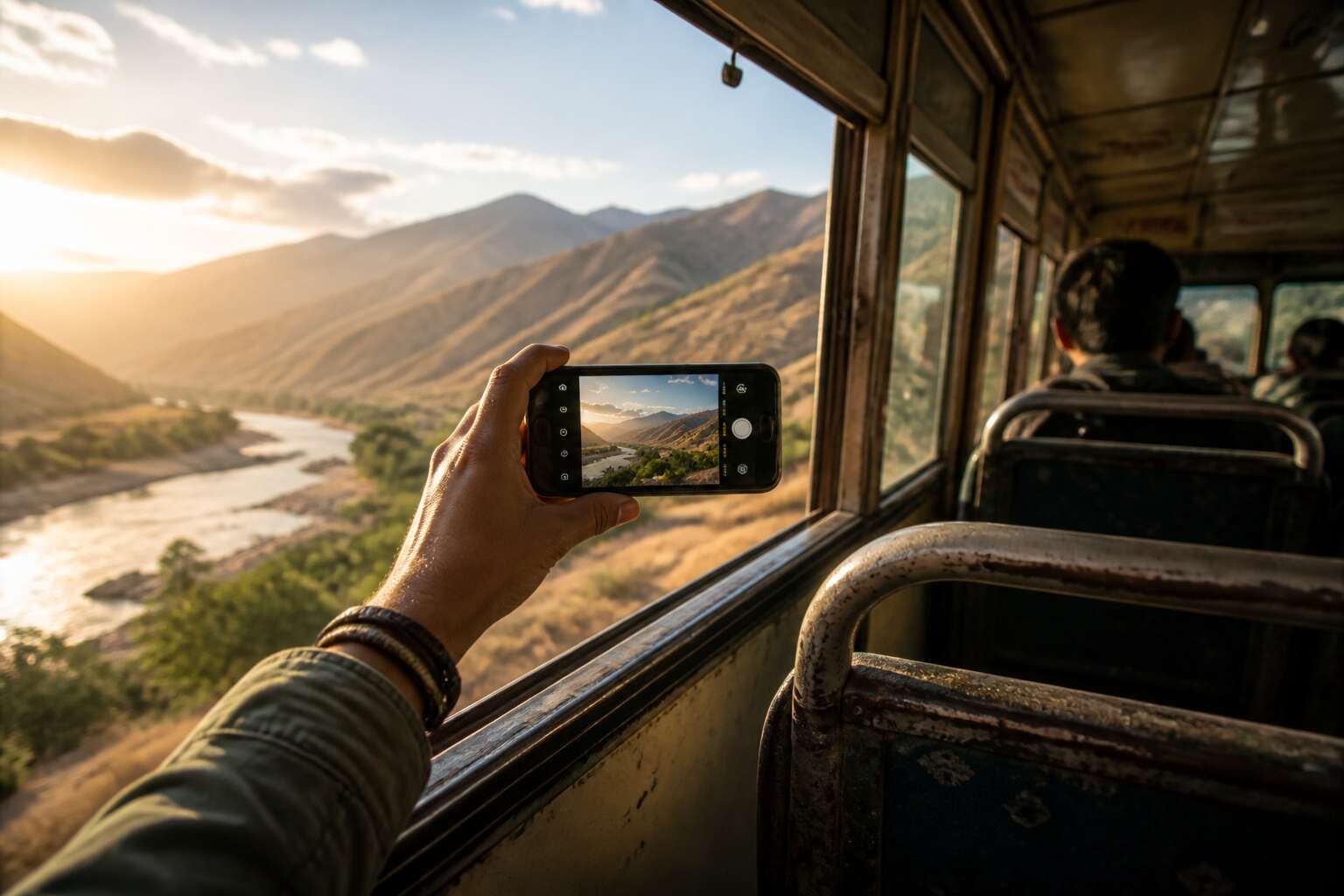
Mastering the Mobile Shot
Choosing the Right Phone Settings for Moving Subjects
Most smartphone cameras default to a shutter speed that freezes a parked car, not a passing landscape. On a moving bus, you need control. I switch to manual mode every time!
Set shutter speed to 1/1000th of a second to freeze motion. Raise ISO to 400 or 800 to handle shifting light. Tap to focus on the horizon, not the window glass.
These settings work well for moving shots:
- Continuous autofocus tracks subjects as they move.
- Burst mode gives you multiple frames to choose from.
- Disabling HDR speeds up processing between shots.
The payoff is a sharp image of the Karoo, the coast, or the city. Your bus travel snap ideas gain clarity without the usual blur.
Burst Mode and Continuous Capture Techniques
The landscape outside a bus window is a murk of half-seen forms. Mountains dissolve into shadow. A village materialises and vanishes in the same breath. Burst mode is the only way to catch these fleeting moments. Hold the shutter and the camera records a dozen frames in a heartbeat. One holds the truth you saw.
Continuous capture works best when you predict the moment. The bus rounds a curve. The light shifts. A passerby turns their head. I press and hold, gathering frame after frame. Most frames will be useless, but one will be the shot.
Some habits define the method:
- The phone pressed against the window frame holds steady
- Short bursts of three or four frames cover the movement
- The immediate review shows what worked
For the traveller chasing bus travel snap ideas, these split seconds are the whole game. The road will not pause. Neither will the light.
Propping and Stabilizing Your Device on the Seat
The window seat provides a stable surface only in theory. In practice, the bus shudders at every speed change. Rest your elbow on the padded sill and let the phone sit in your palm. Press the edges of the device against the glass, but wipe the glass first to avoid a smudged frame.
For bus travel snap ideas, consider the available supports:
- The seat back ahead, which requires its occupant to sit still
- The folded tray table, which wobbles but accepts a flat press
- The headrest of the seat before you, which works for over-the-shoulder angles
The better method is to become the support yourself. Place both feet flat on the floor. Draw your knees together. Rest your arms on your thighs and hold the phone steady. I have used this pose on many a long haul. You will look odd, but you will hold the shot. The other passengers will assume you are inspecting the upholstery. Let them!
Cleaning the Lens for Smudge-Free Results
Your phone’s lens has a remarkable talent for collecting filth. Dust from the N1, biltong crumbs from two rows back, and the faint smear of your own sunscreen all appear in your frame with alarming fidelity. The first rule of bus travel snap ideas: wipe the glass before you trust it.
Microfiber cloths work. Your t-shirt does not, because fabric softener leaves a residue that refracts light. Breathe on the lens to fog it, then wipe in circles from the center outward. A carbon-tipped lens pen handles stubborn debris that wipes refuse to shift. Trust me, you will feel the difference before you see it.
The enemies of a clean shot are predictable:
- The condensation on a cold window that mists back onto your phone
- The oily film from handling your device during every gear change
- The dust that collects in your pocket between stops
Check the lens before each composition. Your bus travel snap ideas deserve better than a blurry grey veil.
Composition Techniques for Rolling Landscapes
Framing the Window as a Natural Border
I have watched entire provinces reshape themselves from a bus window, and each time the frame of the glass decides what the image becomes. For bus travel snap ideas, rolling landscapes demand deliberate framing. The window is your best ally. Use its edges as a natural border, locking the foreground to the glass while the terrain shifts beyond the pane.
Place the horizon line where it serves the scene:
- Low for expansive skies over the Karoo flats.
- High for textured earth and rocky outcrops.
- Centered when the road itself anchors the composition.
The eye line follows the road’s curve. The glass, the sill, and the metal rail hold the scene together, giving the image structure the open road cannot offer.
Leading Lines with Highways and Power Cables
Dust from the highway hangs over the gravel road behind the bus. Ahead, the tar curves and the eye follows. Highways are the obvious leading lines, but do not ignore power cables. They stretch across the Karoo in long, deliberate strokes. They pull your gaze through the frame when the landscape itself offers no natural path.
I have taken some of my best bus travel snap ideas this way. Let the road run from the bottom corner. Let the cables cross the upper third at an angle. The visual tension between those two lines creates a composition that holds.
For rolling landscapes, this works best with a clear hierarchy:
- Place the road in the foreground, cables above.
- Keep the horizon low.
- Wait for the bus to crest a rise.
The landscape does the rest.
Capturing Foreground and Background Layers
Rolling landscapes are deceptive. Through the window they appear to swell and dip, but a single flat shot loses that rhythm. The strongest bus travel snap ideas depend on separation between foreground and background layers.
On roads through the Middelburg district, I search for texture at the edge of the road. Broken earth, clumps of Karoo bossies, a strand of rusted fencing. These objects are small, but for bus travel snap ideas they create the needed depth. Without them, the eye drifts across an empty frame.
- Foreground scrub or rocks near the road
- A middle band of low hills or outcrops
- A distant mountain range against the sky
The road curve helps divide these bands. When the bus drops into a dip, hold the frame level and let the foreground fill the bottom third. Let the ridges stack upward. The overlap between layers creates the sense of movement across the landscape.
Using the Rule of Thirds for Scenic Drives
Any photographer who has wrestled with a horizon will tell you that gravity is not the only force at play. On a scenic drive, the rule of thirds rescues your composition from the tyranny of a dead-center split. Instead of letting the road cut the frame in half, pin the sky to the top gridline and let the hills occupy the lower two-thirds. This gives the eye a clear path across the frame.
For stubbornly flat landscapes, try this checklist:
– Locate the strongest ridge line and slide it onto the upper horizontal gridline
– Let a lone wind pump or distant koppie sit on the intersection point
– Use the bus’s gentle rocking to time the shot when the road dips into a hollow
These bus travel snap ideas turn an ordinary roadside view into something with structure. The rolling terrain supplies the motion; your grid supplies the reason. When the horizon wobbles, the rule of thirds keeps it honest.
Experimenting with Symmetry and Repeating Patterns
The landscape repeats itself with a stubborn rhythm. Hills roll in measured waves, each one a mirror of the last. On the bus, I count the telegraph poles as they tick past. Symmetry finds you here:
- A lone acacia mirrored in a rain puddle
- Two identical koppies flanking the road
- Fence lines stitching the veld into quilted squares
Repetition gives the eye a fixed point. When the bus rounds a bend, the arrangement shifts, and a new symmetry emerges. For bus travel snap ideas, watch for the repetition in the land: a row of wind pumps, the shadow of the bus stretching alongside. The sameness feels almost hypnotic, a quiet menace in the order.
Working With Window Light and Reflections
Timing Shots Around Golden Hour
Golden hour transforms a mundane bus window into a living canvas. As the sun dips toward the Karoo horizon, every bump in the road sends a shaft of amber light sweeping across the interior. Shadows stretch long across the seats, perfect for capturing the quiet drama of a passing landscape. During this fleeting window, you have a short list of opportunities:
– Watch for dust particles dancing in the low light beams.
– Position your phone to catch the sun’s reflection on the glass.
– Anticipate how the aisle lights flicker as dusk settles.
After the sun disappears, the balance shifts. Artificial lights inside the bus bounce off the glass, creating layered reflections of passengers and the darkening outside world. Timing your snaps around this change yields dynamic results, especially when the sky blushes purple and orange. The brief twilight period offers rich tones that fade quickly. For compelling bus travel snap ideas, patience is key; wait for the bus to round a bend that opens up the view to the west.
Managing Glare and Overexposure
Window light is a fickle collaborator. During a long haul across the Free State, I learned to tilt my phone until the sun’s glare dissolved into a soft bloom. Overexposure erases detail, so tap the brightest patch of glass and let the shadows fall where they may. Reflections offer their own grammar. A passenger’s silhouette can merge with a passing windmill, creating a double exposure without any editing. To keep control:
– Rotate your wrist to change the angle of incidence.
– Use the seatback as a temporary lens hood.
– Shoot through a slightly open window when possible.
These adjustments turn harsh light into a tool. The best bus travel snap ideas emerge when you work with what the cabin gives you, not against it.
Using Reflection for Double-Exposure Effects
Some of the most rewarding bus travel snap ideas happen when the window becomes a canvas for layered realities. A reflection turns a sleepy passenger into a ghost hovering over the Karoo. I once caught a fellow traveller’s profile floating above a petrol station, his cap blending with the pumps behind him. No editing required. The trick is patience and a bit of elbow grease on the glass. Smudge the surface, and the mirror image becomes a muddy mess. Clean panes give you crisp, compelling double exposures.
To capture these moments properly:
1. Press your lens flush against the glass to minimise interior reflections.
2. Wait for the bus to slow down so the background stays recognisable.
3. Focus on the reflection, not the view behind it.
These techniques turn ordinary roadside stops into layered stories, and they are the kind of bus travel snap ideas that feel genuinely original.
Storytelling Through Travel Details
Focusing on Your Fellow Passengers’ Expressions
The rolling landscape outside your window tells one story, but the interior of the bus contains a thousand more. When you pivot your lens inward, you discover that the quiet micro-expressions of your seatmate are a living anthology of human experience. The fleeting twitch of a smile during a private daydream, or the furrowed brow focused on a distant memory, offers a candid intimacy that posed portraits rarely achieve.
These unguarded moments are where your bus travel snap ideas evolve into visual narratives. The gentle head nod of a passenger lulled by the engine’s hum, or the wide-eyed wonder of a child seeing the Karoo for the first time, are treasures. To capture them, you must become an observer of the journey, not just a passenger passing through it.
Consider the architecture of the vehicle itself as a stage for these human stories:
- The sleepy traveller leaning against the cold glass, a silhouette framed by passing sunlight.
- Two strangers sharing a quiet laugh over a phone screen, their shoulders shaking in unison.
- The conductor’s weathered hand as he counts tickets, a testament to endless commutes.
Each face is a map of specific places and personal histories. When you focus on these subtle interactions, you move beyond simple documentation. You are threading together the social tapestry of the route, capturing the true rhythm of the road in its most honest, unguarded form. These portraits complete the travel log in a way that scenery alone cannot achieve.
Documenting Snacks, Tickets, and Travel Trinkets
A bus ticket is touched a dozen times before it reaches your pocket, yet most travellers discard it without a thought. That slip of paper holds the route. When I photograph my travel trinkets, I am preserving a record of the journey. For fresh bus travel snap ideas, turn your lens to the small litter of the ride:
A folded till slip from a roadside bakery.
A bottle cap rusted by the damp Karoo air.
A stamp from a post office in a town you will not revisit.
Snacks become geography. Biltong crumbs on a lap, a half-sucked lemon drop rolling along the windowsill. These details anchor the memory of a route. The interior of the bus carries these stories, and the camera rewards a patient eye. These bus travel snap ideas turn the ordinary debris of transit into a curated archive of the road.
Capturing the Driver and the Dashboard Perspective
The driver’s seat is the one place on a bus that no passenger ever occupies. The view from there changes how you understand the journey. The dashboard holds a private collection: a toll card sliding across the plastic, a coffee cup balanced on the console, the odometer ticking past another milestone. For fresh bus travel snap ideas, I turn my lens forward instead of sideways.
The driver’s hands show the physical work of the road. Calloused knuckles on the N2, relaxed fingers on a long Karoo stretch. The rearview mirror catches the road behind, a second story running parallel to the one ahead. The windscreen frames the horizon, while the side mirror holds a shrinking town in its glass.
These bus travel snap ideas capture the journey from the one angle travellers never see. The road ahead holds the next town. The dashboard records the miles already spent.
Highlighting Roadside Signs and Local Typography
Roadside signs narrate the journey. They mark the transition between provinces, between biomes, between the familiar and the unknown. On the N1, a weathered green board points toward Colesberg while a hand-painted placard announces farm stalls forty kilometres on. These bus travel snap ideas rest in the small details:
- The hand-lettered board advertising rusks and boerewors
- The stencilled route number on a concrete pillar
- The faded municipal marker leaning into the wind
Local typography carries its own rhythm. The Karoo favours narrow sans-serifs that match the horizon. City outskirts introduce a different grammar entirely, the stretched letters of overhead gantries blurring at speed. Each sign becomes a frame within the window, a fragment of the regions you pass.
Shooting Through Curves and Tunnel Entrances
The road rarely offers a straight answer, and that is precisely where the narrative hides. As the bus leans into a sweeping bend, the entire frame of your photograph tilts with it, compressing the horizon into a diagonal slash of light and earth. These are the moments where bus travel snap ideas evolve from simple documentation into something more dynamic, a visual record of momentum itself. The turn becomes a character, pulling the landscape past your lens with a deliberate, cinematic drag.
Curves force a choice of focus. You can lock onto the vanishing point where the asphalt folds into the hills, or you can let the foreground whip into a blur of gravel and grass. For the most expressive shots, consider these approaches:
– Compose along the outer edge of the bend, where the road’s arc fills the lower third of the frame.
– Wait for a roadside marker or a lone tree to cross the apex of the curve, anchoring the motion.
– Shoot in short bursts as the bus straightens out, catching the moment the tension in the road releases.
Tunnel entrances offer a different kind of story, a threshold between one landscape and another. The approach is always the same, a dark mouth opening in the rock or hillside, but the transition is never predictable. Inside, the light changes completely. The sodium glow of the tunnel lamps casts a flat, amber tone over every surface, while the exit aperture shrinks to a bright, white slot in the distance. Capturing that compression, the way the world outside narrows to a single point, adds a layer of anticipation to your travel log. The bus travel snap ideas found here are not about the tunnel itself, but about the brief surrender to darkness and the sharp return to daylight on the other side. It is a full stop in the journey, followed by a new sentence.
Editing and Sharing Your Road Trip Gallery
Selecting the Best Frames From a Series
A single frame from a series can tell a story that the rest only hint at. When I review my bus travel snap ideas, I look for the image where light and motion align. That one fleeting second where a passenger’s gesture or a passing landscape element creates tension!
Selecting the best frames requires patience. I compare sequences side by side and ask a simple question: which picture holds attention beyond the initial glance?
1. Sharpness on the main subject, even if the edges blur.
2. A clear focal point that draws the eye naturally.
3. An unexpected detail that photographs often miss.
Then I share the chosen shots with a thoughtful edit. Cropping slightly to improve composition, adjusting exposure for consistency, and never overfiltering. The sequence stays honest to the journey itself.
Applying Presets for Consistent Color Moods
After you pick the strongest frames, the next step is making them feel like one journey. Applying presets for consistent color moods ties the whole gallery together without flattening the variety. I use a single preset as a base, then adjust exposure and temperature per image. This keeps the bus travel snap ideas cohesive while respecting each shot’s unique light.
For sharing, the order matters more than the filter. Group images by narrative beats, not by chronological strictness. A small list helps me stay efficient:
- Sync white balance across all shots first.
- Set the same preset strength for every frame.
- Export at the same resolution.
Keep the edits modest. The goal is to share a visual log, not an overprocessed fantasy. When the color mood stays consistent, the gallery reads as a single day, not a random collection.
Cropping to Remove Distracting Window Edges
Crop before you post. The window frame that worked in the moment can dominate the final image. A thin strip of seat fabric or a smudge on the glass pulls the eye away from the landscape. I zoom in slightly to cut these edges, keeping the aspect ratio consistent across all images.
When I crop, I check for:
- Edges of the window frame that crept into the shot
- Reflection streaks that cut across the sky
- Seatbelts or headrests that broke the clean line
This approach applies directly to your bus travel snap ideas. For a cleaner gallery, I use the same grid every time. The bus travel snap ideas retain their original energy without the visual noise of unexpected borders.
The process is quick. I check each frame in order, crop the distractions, then move on. No need to overthink it. A consistent crop creates a rhythm that the viewer follows without noticing.
Creating a Photo Series for Social Media
Curating a road trip gallery requires restraint. After a long journey, you might have hundreds of frames. The bus travel snap ideas that survive are the ones that tell a single narrative. I edit in passes, first deleting obvious blurs, then pairing images that relate to each other. A dawn shot beside a dusk shot creates continuity.
For social media, I arrange the series in a deliberate order. Opening with a wide landscape, following with a close detail, and ending with a passenger portrait. This sequence holds attention. I use the same caption structure for each post, starting with the location and ending with a small observation.
- Check the first and last image for impact
- Confirm each image has a distinct subject
- Ensure the color tones match across the gallery
Sharing is a straightforward process. I upload, tag the stops, and let the sequence stand. The bus travel snap ideas gain meaning through their arrangement and their content.


0 Comments